
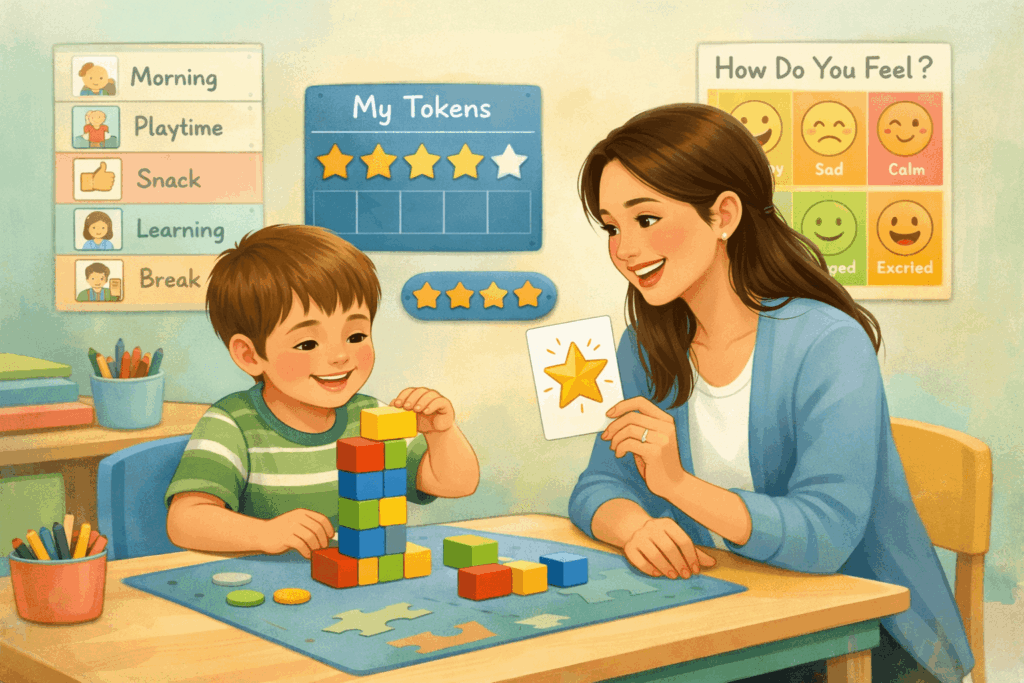
Applied Behavior Analysis (ABA) therapy offers evidence-based solutions for addressing challenging behaviors in children with autism and developmental disabilities. Rather than relying on punishment-based approaches, modern ABA therapy emphasizes positive reinforcement and skill-building strategies that create lasting behavioral change while preserving children’s dignity and emotional well-being.
Applied Behavior Analysis (ABA) therapy represents the gold standard in behavioral intervention for children with autism spectrum disorder. Recognized by leading organizations including the American Psychological Association, ABA therapy applies scientific principles of learning and behavior to create meaningful change in socially significant behaviors.
At its foundation, ABA therapy examines the three-term contingency: antecedents (what happens before a behavior), the behavior itself, and consequences (what follows the behavior). By systematically analyzing these components, Board Certified Behavior Analysts (BCBAs) develop targeted interventions that address the root causes of challenging behaviors rather than simply suppressing symptoms.
Discrete Trial Training (DTT) breaks complex skills into manageable steps, teaching each component systematically with clear instructions, prompts, and reinforcement. This structured approach proves particularly effective for teaching foundational skills.
Natural Environment Teaching (NET) leverages children’s interests and daily routines to promote learning in authentic contexts. By embedding instruction within naturally occurring activities, NET enhances skill generalization across settings.
Task Analysis deconstructs multi-step activities into sequential components, enabling therapists to teach complex behaviors systematically while identifying specific points where children may need additional support.
Learn more about the ABC model of behavior that forms the foundation of effective ABA interventions.
Positive reinforcement stands as the cornerstone of effective ABA therapy. This approach involves delivering a preferred consequence immediately following a desired behavior, increasing the likelihood that behavior will occur again. According to the Association for Behavior Analysis International, positive reinforcement creates sustainable behavioral change without the adverse effects associated with punishment-based methods.
Social Reinforcement includes verbal praise, high-fives, smiles, and attention from valued individuals. For many children, social recognition serves as a powerful motivator for appropriate behavior.
Tangible Reinforcement involves access to preferred items such as toys, snacks, or privileges. These concrete rewards can be particularly effective when paired with social reinforcement.
Activity Reinforcement grants access to preferred activities like playground time, sensory play, or special games, capitalizing on children’s natural interests to motivate positive behavior.
Token Economy Systems allow children to earn tokens for displaying target behaviors, which can later be exchanged for backup reinforcers. This approach teaches delayed gratification while providing immediate feedback.
Unlike punishment, which may temporarily suppress behavior while creating anxiety and damaging therapeutic relationships, positive reinforcement builds confidence, strengthens rapport, and fosters intrinsic motivation for appropriate behavior.
Challenging behaviors are actions that interfere with learning, social development, and safety. When addressing challenging behaviors with ABA therapy, the focus extends beyond simply stopping unwanted actions—it involves understanding why these behaviors occur and teaching functionally equivalent alternatives.
Aggressive Behaviors such as hitting, kicking, biting, or pushing others can create safety concerns and social barriers. These behaviors often serve communication functions for children with limited verbal skills.
Self-Injurious Behaviors (SIB) including head-banging, skin-picking, or self-hitting pose serious health risks and require immediate intervention with careful analysis of maintaining variables.
Tantrum Behaviors characterized by crying, screaming, dropping to the floor, or throwing objects can significantly disrupt learning opportunities and family routines.
Property Destruction such as breaking toys, throwing items, or damaging furniture creates financial burden and safety hazards while potentially serving escape or attention functions.
Non-Compliance or refusal to follow instructions impedes skill acquisition and creates challenges across home, school, and community settings.
Elopement or running away presents serious safety risks and requires environmental modifications along with teaching appropriate communication of needs.
Understanding these behaviors requires looking beyond their topography (what they look like) to their function (what they accomplish for the child). This functional perspective is central to addressing challenging behaviors with ABA therapy effectively.
Explore how ABA therapy supports emotional regulation to prevent meltdowns and teach self-control skills.
A Functional Behavior Assessment (FBA) represents the essential first step in addressing challenging behaviors with ABA therapy. As outlined by the Behavior Analyst Certification Board (BACB), the FBA process systematically identifies the environmental variables maintaining challenging behaviors, enabling development of function-based interventions.
Indirect Assessment involves interviews with parents, teachers, and caregivers to gather historical information about the behavior, including when and where it occurs, potential triggers, and typical consequences.
Direct Observation requires trained professionals to observe the child across multiple settings and times, documenting antecedents, behaviors, and consequences as they occur naturally.
Data Collection systematically tracks frequency, duration, intensity, and latency of target behaviors, providing objective information about behavior patterns.
Hypothesis Development synthesizes assessment information to determine the behavior’s function: attention-seeking, escape/avoidance, access to tangibles, or automatic/sensory reinforcement.
By identifying the function, BCBAs design interventions that address the underlying need rather than merely suppressing the behavior—a hallmark of addressing challenging behaviors with ABA therapy without punishment.
Modern ABA therapy employs multiple positive strategies that reduce challenging behaviors while teaching functional alternatives. These approaches align with ethical guidelines established by the BACB Professional and Ethical Compliance Code.
Differential Reinforcement of Alternative Behavior (DRA) reinforces a specific appropriate behavior that serves the same function as the challenging behavior. For example, teaching a child to raise their hand for attention instead of calling out.
Differential Reinforcement of Incompatible Behavior (DRI) reinforces a behavior that physically cannot occur simultaneously with the challenging behavior, such as reinforcing sitting appropriately when the target is to reduce running around.
Differential Reinforcement of Other Behavior (DRO) delivers reinforcement when the challenging behavior does NOT occur during a specified time interval, gradually teaching the child to refrain from the behavior.
Differential Reinforcement of Low Rates (DRL) reinforces the challenging behavior when it occurs at a lower rate, useful for behaviors that cannot be eliminated immediately but should be reduced gradually.
Functional Communication Training (FCT) teaches children to use appropriate communication methods to access the same outcomes their challenging behaviors previously produced. Research published in the Journal of Applied Behavior Analysis demonstrates FCT’s effectiveness across populations and settings.
For a child who hits to escape difficult tasks, FCT might teach them to use a “break” card or sign. For a child who screams for attention, FCT might teach them to tap someone’s shoulder or use verbal requests.
Discover how ABA therapy supports language development to build functional communication skills.
Modifying what happens before challenging behaviors significantly reduces their occurrence:
When addressing challenging behaviors with ABA therapy, environmental design plays an equally important role as direct intervention strategies. A thoughtfully structured environment prevents challenging behaviors before they occur while promoting skill development and independence.
Organized Spaces with clear boundaries and designated activity areas help children understand expectations and reduce confusion that may trigger challenging behaviors.
Sensory-Friendly Design accommodates individual sensory profiles by controlling lighting intensity, noise levels, visual clutter, and tactile experiences throughout the environment.
Safety Measures ensure the environment minimizes risks while allowing children freedom to explore and learn, particularly important for children who engage in elopement or property destruction.
Accessibility ensures all materials, visual supports, and communication tools remain within children’s reach, promoting independence and reducing frustration.
Visual supports transform abstract concepts into concrete, visible information that children can reference independently:
The National Autism Center’s National Standards Project identifies visual supports as an established, evidence-based practice for individuals with autism.
Successfully addressing challenging behaviors with ABA therapy requires active collaboration between professionals and families. Parents and caregivers possess invaluable knowledge about their child’s history, preferences, and unique characteristics while spending significantly more time with their child than therapists.
Ongoing Communication through regular meetings, progress updates, and daily communication logs ensures consistency between therapy sessions and home environments.
Parent Training equips families with ABA principles and practical strategies for implementing interventions, managing challenging behaviors, and reinforcing positive behaviors throughout daily routines.
Goal Setting Partnership involves families in establishing meaningful, functional goals that align with family priorities and cultural values, increasing motivation and intervention fidelity.
Shared Problem-Solving acknowledges parents as equal team members in addressing challenges, modifying strategies, and celebrating successes.
Generalization Support helps families facilitate skill transfer from therapy settings to home, school, and community environments where children spend most of their time.
Learn about when to start ABA therapy and what to expect during your child’s treatment journey.
Data collection forms the scientific foundation of ABA therapy, enabling therapists to evaluate intervention effectiveness objectively and make informed adjustments. When addressing challenging behaviors with ABA therapy, systematic measurement ensures accountability and guides clinical decisions.
Frequency/Event Recording tallies the number of times a behavior occurs within a specified observation period, useful for discrete behaviors with clear beginnings and endings.
Duration Recording measures how long a behavior lasts from start to finish, appropriate for behaviors that persist over time like tantrums or task engagement.
Latency Recording captures the time between an instruction or event and the onset of a behavior, helpful in measuring compliance or response speed.
Interval Recording divides observation periods into equal intervals and records whether the behavior occurs during each interval, efficient for high-rate behaviors or when continuous observation isn’t feasible.
ABC Data Collection documents antecedents, behaviors, and consequences as they occur, providing rich descriptive information for hypothesis development.
Regular data analysis reveals patterns, trends, and treatment effects:
According to research in Behavior Analysis in Practice, data-based decision making distinguishes ABA from other approaches and ensures interventions remain effective and ethical.
Case examples illuminate how positive, function-based interventions create meaningful change in children’s lives without relying on punishment.
Marcus, a 5-year-old with autism, frequently hit peers and therapists when he wanted access to preferred toys. His FBA revealed that aggression functioned to gain access to tangibles. His BCBA implemented a multi-component intervention:
Within eight weeks, Marcus’s aggression decreased by 87%, while his independent communication requests increased dramatically. His parents reported improved interactions with siblings and expanded social opportunities.
Sophia, a 7-year-old with developmental delays, engaged in head-hitting when presented with complex academic tasks. Her FBA identified an escape function. Her intervention plan included:
After twelve weeks, Sophia’s self-injurious behavior decreased by 92%. She used her break card independently, completed increasingly complex tasks, and demonstrated improved self-confidence.
Ethan, a 4-year-old with autism, exhibited intense tantrums during transitions between activities. His FBA suggested that unpredictability and lack of understanding about upcoming events triggered his behaviors. His intervention included:
Within ten weeks, Ethan’s tantrum behaviors decreased by 78%. His parents reported that mornings and bedtime routines, previously filled with conflict, became more peaceful and predictable.
Read about how ABA therapy builds everyday skills and independence through positive teaching methods.
The field of ABA therapy continues evolving toward increasingly compassionate, person-centered approaches. Contemporary practice emphasizes assent-based treatment, neurodiversity-affirming perspectives, and trauma-informed care while maintaining the scientific rigor that makes ABA effective.
Assent-Based Treatment respects children’s preferences and comfort levels, proceeding with interventions only when children demonstrate willingness to participate, not merely absence of refusal.
Strengths-Based Approach identifies and builds upon each child’s unique abilities, interests, and learning styles rather than focusing exclusively on deficits.
Collaboration with Autistic Self-Advocates incorporates perspectives from autistic adults to ensure interventions promote genuine quality of life and respect neurodivergent ways of being.
Trauma-Informed ABA recognizes that some challenging behaviors may reflect trauma responses and incorporates specialized approaches for children with adverse experiences.
Family Quality of Life Focus ensures interventions not only benefit the child but also reduce family stress and enhance overall family functioning.
Discover how technology is enhancing ABA therapy delivery while maintaining the essential human connection.
Addressing challenging behaviors with ABA therapy without punishment represents both an ethical imperative and an effective intervention approach. By understanding the functions of behavior, implementing positive reinforcement strategies, teaching functional alternatives, and creating supportive environments, BCBAs help children develop meaningful skills while preserving their dignity and emotional well-being.
The evidence overwhelmingly supports positive approaches. Children exposed to reinforcement-based interventions demonstrate better outcomes, stronger therapeutic relationships, and enhanced emotional health compared to those subjected to punishment-based methods. Families report greater satisfaction, improved stress levels, and increased confidence in supporting their children’s development.
As parents, caregivers, and professionals, we have a responsibility to employ the most effective and compassionate strategies available. Modern ABA therapy offers powerful tools for creating lasting positive change—tools that honor children’s individuality, respect their experiences, and foster genuine growth.
If you’re seeking support for a child displaying challenging behaviors, consider partnering with a provider committed to positive, evidence-based practices. Explore telehealth ABA therapy options or virtual ABA therapy services that bring quality intervention directly to your home. Contact Step It Up ABA to learn how our team of experienced BCBAs can develop an individualized plan that addresses your child’s unique needs while fostering positive development and family success.
Through collaboration, scientific rigor, and unwavering commitment to compassionate care, we can unlock every child’s potential and create brighter futures for children with autism and developmental disabilities.